
Market news· 5 min read
Jeffrey Soffer Faces Lawsuit Over Aventura Towers
Jeffrey Soffer and the City of Aventura are being sued over two towers at Turnberry Isle. What is in dispute and what it means for the market.
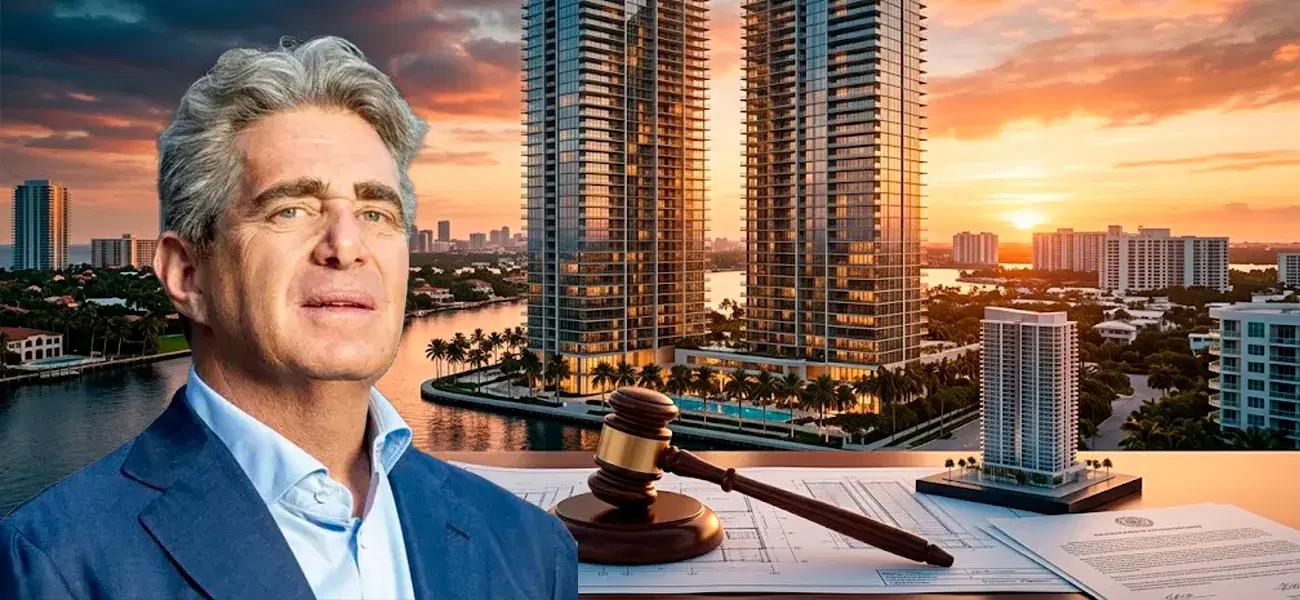
A real estate dispute at one of Aventura’s best-known residential complexes is pitting condominium owners against the City of Aventura and one of South Florida’s most influential developers.
Turnberry Isle owners filed a lawsuit over plans to build two new residential towers inside the complex. The defendants include entities linked to developer Jeffrey Soffer in Aventura and the City of Aventura itself.
The conflict goes far beyond two new buildings. At its center are the allowed density, the decisions made by local authorities and a question that comes up more and more in South Florida: how do you balance real estate growth with the rights of the people who already live in a community?
What is planned at Turnberry Isle?
The plans for the former Turnberry Isle Yacht Club include two residential towers of roughly 24 stories each, with about 274 units in total.
That is a significant addition to an established Aventura community, which is exactly why the project has drawn opposition from some owners.
The lawsuit challenges the decisions that allowed the development to move forward and argues, among other claims, that certain approvals would permit a building intensity higher than what the owners consider was originally authorized.
That point will be central to the case.
Still, the fact that one side makes those allegations does not mean a court has already found the approvals unlawful. The case will have to go through the corresponding legal process.
Who is Jeffrey Soffer and what is his impact on Aventura?
The name behind the controversy is especially relevant for the local market.
Jeffrey Soffer is chairman and CEO of Fontainebleau Development and belongs to a family closely tied to the real estate history of Aventura and South Florida.
His track record includes some of the region’s best-known assets and developments, including:
- Fontainebleau Miami Beach
- JW Marriott Miami Turnberry Resort & Spa
- Turnberry Ocean Club
The Soffer family’s history in Aventura goes back several decades and is tied to the development that helped turn this part of northern Miami-Dade into one of the county’s leading residential, commercial and luxury markets.
That is why this is not simply a dispute between residents and a builder who just arrived in town. It is a controversy involving one of the names with the greatest weight in Aventura’s real estate evolution.
Why are the owners suing?
The controversy centers mainly on what can be built on the land and how the necessary approvals were obtained.
The owners who filed the lawsuit challenge decisions by the City of Aventura related to the project and seek to stop the development from moving forward under the conditions currently approved.
To understand why this matters, you have to look beyond Turnberry Isle.
In highly developed markets such as Aventura, Miami Beach, Sunny Isles Beach or Brickell, finding large available sites is increasingly difficult. As a result, much of the future growth happens through redevelopment: changes of use, higher density or the replacement of existing properties.
And when what can be built on a site changes, its value can change dramatically too.
The real value lies in what can be built
This case offers a particularly important real estate lesson:
- For the developer: getting approval to build dozens or hundreds of additional units on the same lot makes an enormous difference to a project’s economic viability and profitability.
- For existing residents: more density means more traffic, long construction periods, lost open views, more pressure on infrastructure and a significant change to the setting they originally bought into.
That is where much of the current conflict in Aventura comes from.
Does the influence of large developers decide how a city grows?
The case inevitably raises this question as well.
Large developers have the capital, lawyers, consultants, architects and specialized teams to navigate extremely complex planning processes. They also tend to have institutional relationships built over decades of business activity.
That gives them a capacity to act that an individual owner can hardly match.
But having influence is not the same as having done something improper.
So far, the reported controversy concerns the planning approvals and whether they were lawful. The lawsuit should not be confused with a proven accusation of corruption or bribery.
That is precisely what makes the case interesting: it forces us to look at where a developer’s legitimate ability to defend and maximize a project ends, and where a city’s obligations to its rules and residents begin.
Aventura keeps growing even as available land runs out
The dispute comes at a time when Aventura is still under strong development pressure. Its location between Miami and Fort Lauderdale, access to Biscayne Boulevard, Aventura Mall, Brightline and its proximity to Sunny Isles Beach have made the city a particularly attractive market for domestic and international buyers.
But Aventura has one feature that will increasingly shape its future: very little undeveloped land is left.
That means many of the next big projects will probably not rise on completely empty sites. They will come from existing properties that are rebuilt, expanded or rezoned. Turnberry Isle is a good example of this new stage.
What could happen to the two towers now?
Filing a lawsuit does not automatically mean the project has been canceled. The court process will have to decide whether the owners’ claims have merit and what effect, if any, they will have on the approvals granted.
Depending on the outcome, the project could move forward, be modified or face new obstacles.
For condo buyers and owners in Aventura, the case also shows why analyzing only the apartment is not enough before buying:
Real estate tip: it pays to understand which sites surround the building, who controls them, what their zoning allows and which projects have been proposed or approved nearby. An open view today will not necessarily be an open view ten years from now.
A case that may say a lot about Aventura’s future
The two proposed towers represent about 274 new residences, but this real estate battle matters far more than that.
The case brings together three forces that are shaping the future of much of Miami-Dade:
- The need to keep developing.
- The enormous economic value of increasing density.
- The resistance of established communities to changes that can alter their surroundings.
Jeffrey Soffer and his family have taken part in Aventura’s transformation for decades. Now some of the residents of that same community are turning to the courts to question how far that transformation can go.
The outcome will matter to the parties involved, but it is also worth following because it reflects a discussion we will likely see repeated in many other parts of South Florida: when almost all the valuable land is already developed, who decides how much more can be built?
Have a question about this?
Alejandro can tell you what it means for your purchase, sale or investment.
Ask Alejandro on WhatsApp